Mastering Digital Health: Inside the XiA Learning Families
As Europe steps into a more connected healthcare future with the upcoming European Health Data Space (EHDS), the need for specialied skills in health data interoperability has never been more urgent. To make seamless, cross-border health data exchange a reality, IT specialists, hospital managers, and healthcare professionals all need targeted, practical training.
To meet this challenge, the Xpanding Innovative Alliance (XiA) has moved away from rigid, one-size-fits-all courses. Instead, we have created a flexible, modular system of learning. Here is a look under the hood at how our educational framework is built.
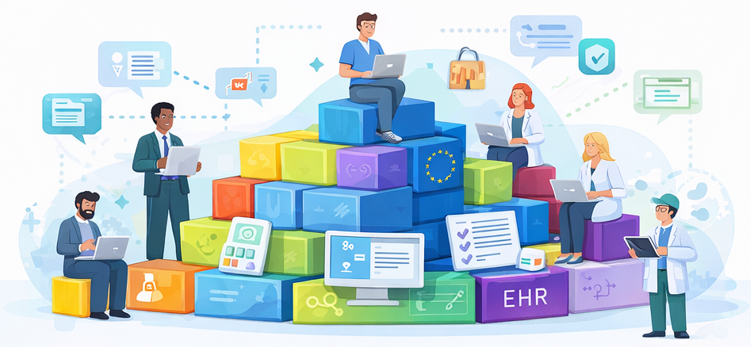
The Building Blocks: Micro-Content and Learning Families
At the core of the XiA Framework are Micro-Content Learning Blocks (MCLBs)—small, self-contained learning units focused on a single concept or task. Think of them as Lego bricks of knowledge.
To make these blocks easy to navigate and combine into meaningful courses, we group them into Families of Micro-Content Learning Blocks (FMCLBs). A Family acts as a thematic folder, ensuring that all the blocks inside it share a coherent subject matter and pedagogical consistency.
Driven by Real-World Needs and Competencies
These Families aren’t just theoretical academic exercises. They are built around practical Competencies: the specific combination of knowledge, skills, and attitudes that a professional needs to effectively perform tasks in the real world.
How did we decide which competencies matter most? They were identified and shaped by evidence gathered directly from the healthcare and IT sectors during our extensive XiA Needs Assessment.
Structured for Growth: Bloom’s Taxonomy
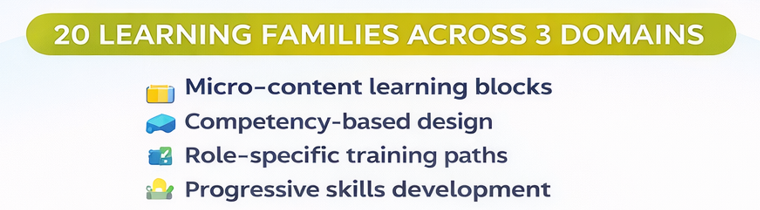
To ensure that the learning journey makes sense, the Learning Outcomes within each Family are structured using educational frameworks like Miller’s Pyramid and Bloom’s Taxonomy.
This means the learning experience is designed to grow in complexity. You don’t jump straight into the deep end; instead, the modules guide you step-by-step:
- Foundational: Acquiring basic factual knowledge.
- Applied: Developing a structural understanding of how concepts connect and work together.
- Specialised: Gaining the deep technical understanding required to integrate and perform these skills in practice.

The Three Umbrella Groupings
To help learners easily find the training that fits their role, the XiA Families are organied into three overarching categories:
- Essentials and Transversals: The shared, fundamental knowledge needed by everyone in the digital health ecosystem.
- EHDS and Systems Component: The practical, hands-on modules focusing on specific types of health data and systems prioritied by European regulations.
- Standards and Semantics: The deep-dive technical modules for experts who build, model, and govern the complex languages of health data.
Meet the XiA Learning Families
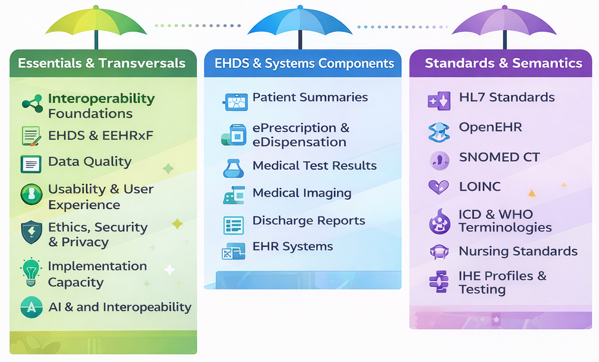
Let’s explore the specific themes covered by our project, categoried under their respective umbrellas.
Essentials and Transversals
These modules lay the groundwork for a shared understanding of digital health across all professions.
- Interoperability Foundations: Covers the core principles of interoperability, explaining the legal, technical, and organisational layers that allow systems to share data across Europe.
- EHDS and EEHRxF: An introduction to the legal framework of the European Health Data Space and the European Electronic Health Record Exchange Format, including the critical distinction between primary and secondary data use.
- Data Quality: Explores why “clean,” complete data is strategically important for safe interoperable services and reliable Artificial Intelligence.
- Usability & User Experience: Focuses on patient-centered design, ensuring that interoperable systems are born intuitive and user-friendly for their users, be they clinicians or information systems specialists.
- Ethics, Security & Privacy: Dives into the critical aspects of data protection, cybersecurity, and GDPR compliance to ensure trust in cross-border data exchange.
- Implementation Capacity: Addresses the “soft skills” of digital transformation, including interprofessional communication, change management, and assessing readiness to adopt new tech.
- AI and Interoperability: Explains how interoperable data powers Artificial Intelligence at the point of care, focusing on decision-making support and clinical workflows.
EHDS and Systems Component
These modules deal directly with the concrete types of medical data that must be shared under new EU regulations.
- Patient Summaries: Details the structure and clinical relevance of the Patient Summary—the most vital snapshot of a patient’s health needed for cross-border care.
- ePrescription, eDispensation, and eProduct Information: Explains the standards and structures required for digital prescriptions, electronic leaflets and the identification of medicinal products (IDMP).
- Medical Test Results: Focuses on the secure and accurate exchange of laboratory and other diagnostic findings.
- Medical Imaging: Teaches the standards required to share medical images (like X-rays or MRIs) and their related reports between different health systems.
- Discharge Reports: Covers the standards for hospital discharge summaries and consultation reports to ensure smooth continuity of care after a patient goes home.
- EHR Systems: Provides an overview of Electronic Health Record systems, exploring their architecture and their role as the primary source of interoperable data.
Standards and Semantics
Designed heavily for developers and IT implementers, these modules explore the technical languages that make health systems “talk” to one another.
- HL7 Standards: Covers essential messaging standards and API-based exchanges, from older formats like CDA to the modern FHIR standard.
- OpenEHR: Introduces an alternative and complementary approach to building Electronic Health Records, focusing on rich semantic modeling and long-term data storage.
- SNOMED CT: A deep dive into the global clinical terminology that ensures medical concepts (like diagnoses and symptoms) mean the exact same thing to every computer system.
- LOINC: Explores the international standard specifically used for identifying laboratory tests and clinical observations.
- ICD & WHO Terminologies: Covers the World Health Organization’s classic classification systems for diseases, interventions, and functioning.
- Nursing Standards: Focuses on the specialied classifications and documentation systems needed to accurately capture nursing care.
- IHE Profiles & Interoperability Testing: Teaches how to use practical integration profiles and testing platforms (like Gazelle) to prove that different software systems can successfully exchange data.
By breaking down complex digital health concepts into these targeted, needs-based Families, the XiA Framework ensures that Europe’s health workforce can acquire exactly the skills they need to navigate the future of healthcare.
Author : Simon Lewerenz