XiA Pedagogical Strategy
The XiA pedagogical strategy defines how learning content within the project is designed, structured and delivered. It ensures that all educational materials produced by XiA follow a coherent, high-quality approach that supports the development of practical interoperability skills in the context of the European Health Data Space (EHDS).
The strategy focuses on the creation of modular micro-learning content and stackable learning modules that can support both formal education and continuous professional development. By combining short, focused learning units with competency-based design, XiA enables flexible learning pathways adapted to the needs of healthcare professionals, digital health developers and public sector stakeholders.
The pedagogical framework builds on recognised European educational frameworks such as the European Qualifications Framework (EQF), ECTS, and DigCompEdu, and integrates established instructional design models. It also aligns with the XiA interoperability skills framework, ensuring that the learning content developed in the project directly supports the competencies required to implement digital health interoperability in practice.
The strategy is organised around seven key pedagogical themes:
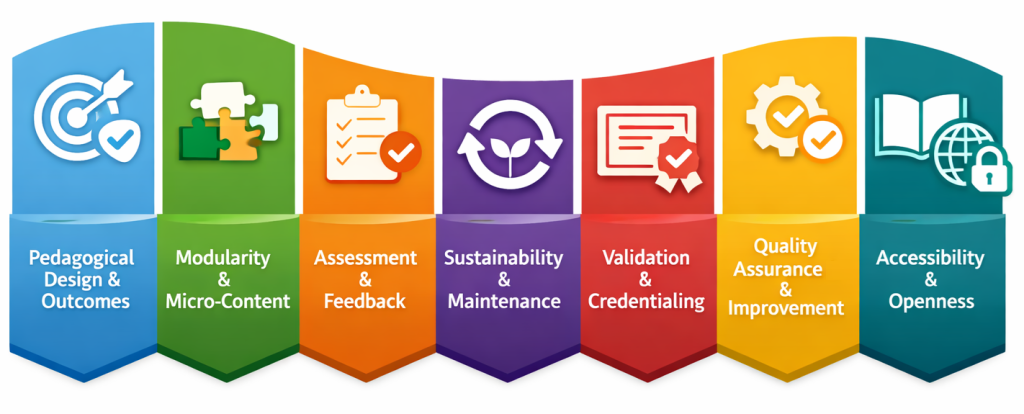
Together, these principles ensure that XiA learning resources remain learner-centred, scalable and adaptable across different educational contexts and professional roles across Europe.
🎯 Pedagogical design and learning outcomes
XiA learning content is designed around clearly defined learning outcomes linked to the interoperability competencies identified in the project. Each module focuses on practical skills required to implement digital health standards and data exchange frameworks in real-world environments. This outcome-driven approach ensures that learning activities remain directly connected to professional practice.
🧩 Modularity and micro-content development
XiA adopts a micro-learning approach based on short, focused learning units that can be combined into larger modules. This modular structure allows learners to progressively build competencies while enabling institutions to integrate XiA content into different training programmes. The approach also supports flexible learning pathways adapted to diverse professional roles.
✔️ Assessment and feedback mechanisms
Assessment in XiA is designed to support both knowledge acquisition and practical understanding. Learners are guided through quizzes, exercises and applied activities that help consolidate their understanding of interoperability concepts and standards. Feedback mechanisms ensure that learners can track their progress and identify areas for improvement.
🔄 Sustainability and long-term maintenance of learning resources
The XiA pedagogical framework is designed to ensure that learning resources remain usable and relevant beyond the lifetime of the project. Content is structured in a way that allows updates as standards, regulations and technologies evolve. This approach supports the long-term sustainability of the educational materials developed within the project.
🎓 Validation and credentialing of learning achievements
XiA explores mechanisms for recognising the competencies acquired through its learning modules. This includes alignment with European qualification frameworks and the potential use of micro-credentials to certify learning outcomes. The objective is to ensure that acquired skills can be recognised across institutions and professional contexts.
⚙️ Quality assurance and continuous improvement
Quality assurance is embedded throughout the development and delivery of XiA learning materials. Internal review processes, testing phases and feedback from learners and stakeholders contribute to continuous improvement. This iterative approach ensures that the content remains pedagogically sound and relevant to evolving interoperability needs.
🌍Accessibility and openness of educational materials
XiA promotes accessible and inclusive learning resources that can be used by a wide range of learners across Europe. Educational materials follow principles of openness and accessibility, enabling reuse and adaptation where possible. This contributes to the broader goal of strengthening interoperability skills across the European health ecosystem.
Authors : Virve Pekkarinen, Outi Ahonen & Luc Chatty