Shaping the Future of Digital Health: Understanding XiA Learner Groups
In an era where digital health systems must communicate seamlessly, the XiA project has reached a crucial milestone in defining the interoperability skills required for the modern workforce.
By bridging the gap between technical standards and clinical practice, XiA aims to provide a structured pathway for professionals to build their competencies. In doing so, the project shifts the focus from software functionalities alone to the people, skills, and collaborative practices needed to achieve effective interoperability in healthcare.
Interoperability is a Human Skill, Not Just a Software Feature
For too long, we have treated interoperability as a “back-office” problem for IT departments to solve with APIs. The XiA project reframes interoperability as a professional competency, that belongs in the clinic and the boardroom, not just the server room. When data doesn’t flow, clinical decision-making suffers and the continuity of care is broken.
To fix this, we must empower a diverse range of stakeholders, from frontline nurses to procurement officers, with the specific skills to manage and utilise interoperable systems.
To achieve this, it is necessary to address the diverse range of professionals involved in the development, implementation, and use of interoperable digital health systems. This shift ensures that digital tools actually support the healthcare mission rather than complicating it. It moves us away from a world of isolated “tech tasks” toward a unified ecosystem of professional excellence.
The Talent Search: From 11 to 3
We started with a Systematic Literature Review (SLR) using the Preferred Reporting Items for Systematic reviews and Meta-Analyses (PRISMA) guidelines. The review initially identified 11 relevant professional profiles involved in interoperable digital health ecosystems, including different types of healthcare professionals, IT professionals, policy makers, and even patients. This was essential to move toward the implementation of the European Health Data Space (EHDS). As regulations evolve, the healthcare workforce needs a validated, replicable skill set that can stand up to legal scrutiny and technical audits, ensuring robustness across international borders.
To support the development of scalable and effective training pathways, the XiA project consolidated the identified 11 professional profiles into three learner groups. This approach enabled a more structured competency mapping process, facilitated the creation of reusable learning pathways, and simplified the personalisation of training according to the specific roles and responsibilities of different healthcare stakeholders.
Meet the XiA Learner Groups
XiA segments the workforce into three primary learner groups, each with a unique focus on how they interact with interoperable health data.
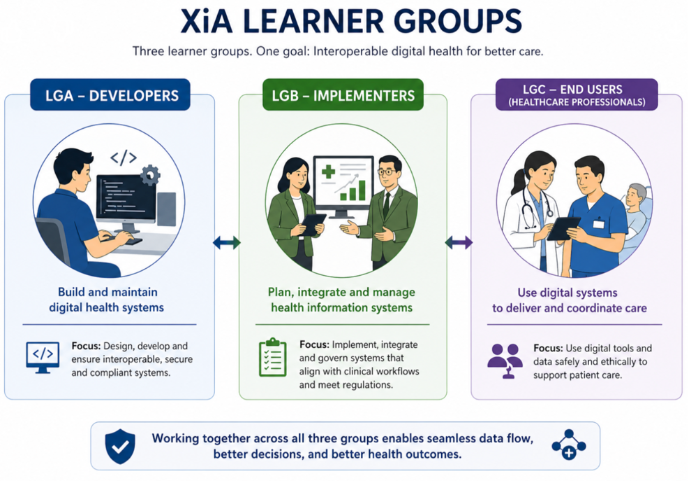
- Developers (LGA): Professionals who build and maintain digital health systems and content. They include software developers, EHR and IT system engineers, data managers, and staff from hospital IT departments. Their focus is on designing, developing, maintaining, and ensuring the interoperability of electronic health records (EHRs) and other health information systems.
- Implementers (LGB): Professionals who plan, procure, implement and manage Health Information Systems (HIS). They include hospital or health IT managers, Chief Medical Information Officers (CMIOs) or Chief Information Officers (CIOs), procurement officers, and digital transformation leads. Their focus is on implementing, integrating, and supervising the use of EHR systems, under a structured governance framework, ensuring they align with clinical processes and meet legal and other regulatory requirements, all while remaining performant.
- End-Users (LGC): Professionals who use HIS directly in care or in care coordination. They include doctors, nurses, allied health professionals, and clinical or process managers. Their focus is on using EHR systems and other digital tools in their daily practice, improving patient care, coordinating care, and ensuring patient safety as well as the ethical use of patient/personal data.
Why This Matters
The XiA project is a blueprint for a future where IT professionals, managers, and healthcare providers finally speak a common language. By moving from fragmented data environments to a unified skills ecosystem, it creates an ecosystem where the developer’s code and the clinician’s decision are perfectly aligned.
By categorising the workforce into these three clusters, XiA will enable the creation of personalised learning pathways based on Micro-Content Learning Blocks (MCLB).
Whether you are building the systems, managing their integration, or using them at the bedside, the framework ensures you receive the specific training needed to thrive in an evolving digital health lanscape.
We know your time is precious. The rationale for these specific groups is simple: personalised learning pathways.
By mapping technical skills directly to these functional roles, the XiA framework ensures you aren’t learning things you’ll never use. Instead, you get to “stack” your skills in a way that is highly relevant to your daily professional practice.
Ready to find your path? Let’s get interoperable!
Author : Francini Abdul Hak