
By Alexandra Olson (EHMA)
On the 3rd and 4th of December 2025, the Care Summit took place in Brussels, Belgium and was attended by representatives of our partners, the European Health Management Association (EHMA) and Community Support for Clinical Terminologies (CSCT). Hosted by EHMA, the two-day event brought together stakeholders representing health, academia, civil society, EU institutions, and sectors including agriculture, defense, environment, energy, and industry to co-create a Roadmap for a Stronger European Health Union. The aim of the Care Summit was to challenge the traditional framing of health as an isolated issue, proposing a vision of health as a catalyst for innovation, solidarity, and resilience across the Union.
One of the four thematic tracks that was particularly relevant to the work of XiA included ‘Levering the European Health Data Space’ to explore the vast potential of interoperable health data to revolutionise healthcare delivery and research. On the first day of the Care Summit, an interactive panel discussion introduced the European Health Data Space and discussed the opportunities surrounding its implementation as well as the potential barriers that may arise. The importance of enhancing communication efforts to increase public awareness of the benefits of EHDS was highlighted, as well as the need to build upon existing successful data-sharing initiatives rather than creating new systems. Other aspects that were emphasised during this panel included the importance of building public trust through transparent legal and technical frameworks, engaging regional authorities as critical implementation partners for testing multi-level collaboration, and the need for purpose-driven data use which focuses on quality, outcomes, and value-based care metrics for integrated planning.
On the second day of the event, the opening plenary session presented a case study entitled ‘Building a common metadata framework to enable cross-border data discovery in the EHDS’ by representatives of Sciensano, the scientific institute for public health of the federal Belgian State. The presentation featured TEHDAS1 and TEHDAS2, Joint Action projects which aim to prepare the ground for the harmonised implementation of the secondary use of health data in the EHDS. When speaking about the goals of the project, XiA was highlighted as one of the current initiatives focused on the primary use of health data, which the TEHDAS2 project would build upon.
One key result of the TEHDAS2 project thus far is guidelines for health data holders on their duties regarding data description. This document provides a clarification of the EHDS health data- including full-text definitions, legislative context, and real-world examples- guidance on the dataset description obligations, an introduction to HealthDCAT-AP (the common metadata model), and detailed, practical instructions for each property of HealthDCAT-AP. The presentation concluded with the sharing of lessons learned, which highlighted the value of involving all stakeholders who will be affected by the implementation of EHDS in the co-creation process, not only the ‘usual suspects’.
The second day of the event also featured a workshop on the EHDS, which resulted in the creation of a set of recommendations that would inform the development of a Roadmap for a Stronger European Health Union. One of the recommendations was particularly relevant to the work of XiA, focusing on providing training modules for hospital IT teams, data stewards, and clinical coders to reduce heterogeneity in metadata and terminologies. If addressed, this recommendation could serve to limit interruptions in workflows and expand the availability of high-quality datasets for research, planning, and evaluation. Other recommendations focused on the creation of national transformation centres to convert primary datasets into EHDS-compliant formats and adopting a bottom-up engagement model involving communities of practice, feedback loops, and shared tooling (ICD-10 maps, FHIR implementation guides) to foster the development of consistent data structures capable of supporting EU-level analytics on a practical level, not just a theoretical one.
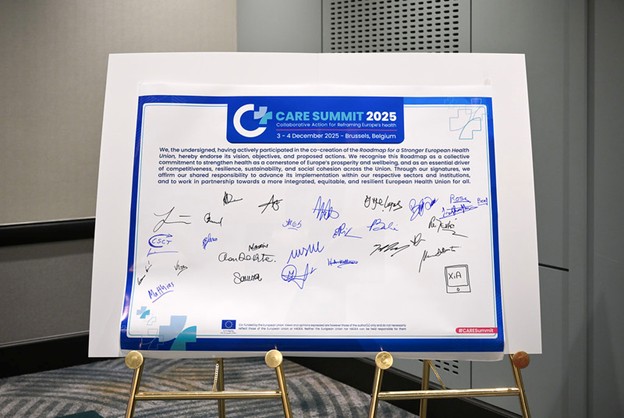
The final session of the conference presented the outcomes of each of the workshops and provided participants with the opportunity to make an actionable commitment to the recommendations within the scope of their work. XiA, of course, indicated the project’s commitment to carry out the recommendations by ”signing” the project’s logo.
If you are interested in watching some of the sessions from the Care Summit, the recordings are available here.