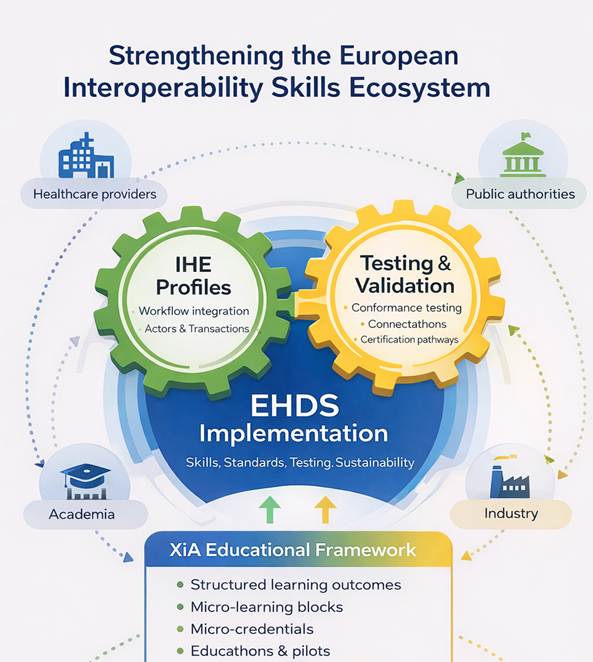
Interoperability in healthcare does not emerge from standards alone. It requires structured learning pathways, practical testing environments, and a shared understanding between educators, implementers and standards organisations.
As an associated partner of XiA, IHE Europe plays a key role in this ecosystem. IHE integration profiles are not only widely adopted across Europe — they also represent one of the core families within the XiA Framework. Alongside HL7-based standards and testing activities, IHE profiles form an essential pillar of interoperability competence.
On 24 March 2026, XiA and IHE Europe will hold a joint education session to deepen this alignment and explore how interoperability training can better reflect real-world needs
IHE and testing as XiA Framework families
Within the XiA Framework, interoperability competencies are structured into thematic families that reflect how interoperability is actually implemented in practice.
IHE profiles constitute a dedicated family because they operationalise workflows across systems, translating standards into executable integration patterns. Understanding IHE is not simply about reading specifications; it requires comprehension of actors, transactions, testing methods, and deployment contexts.
At the same time, Testing & Validation is treated as a transversal family in the XiA model. Testing ensures that interoperability moves from theoretical compliance to demonstrable functionality. It connects specifications to real-world system behaviour and verifies that implementations actually work together.
IHE sits naturally at the intersection of these two dimensions: it defines integration patterns and provides structured testing methodologies to validate them.
From education update to learner-led priorities
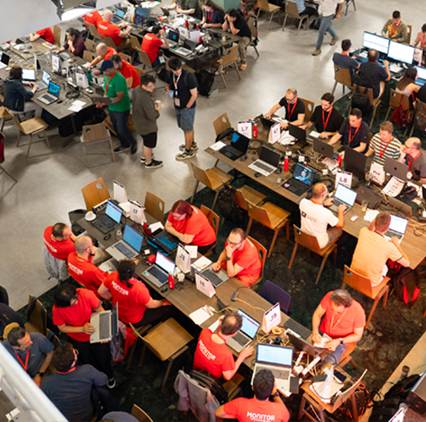
The joint session is deliberately designed as a working dialogue rather than a presentation-based event.
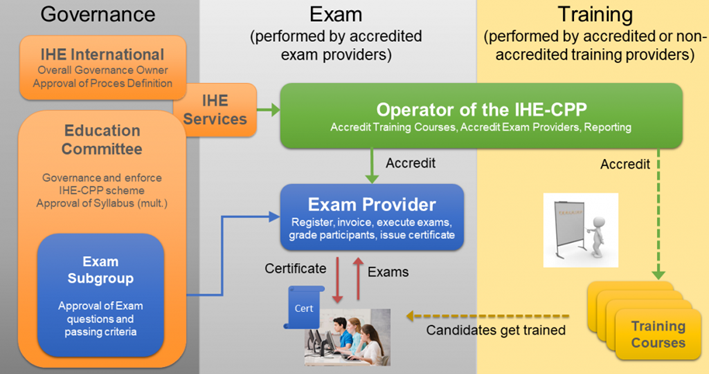
After an update on the evolution of the IHE education syllabus and emerging approaches to assessment — including AI-supported testing — the session will shift toward cross-cutting educational perspectives. Contributors from XiA and partner initiatives will reflect on teaching methods, micro-learning approaches, certification models, and sustainability of educational content.
The core of the session places learners at the centre. Developers, implementers, healthcare organisations and educators will be invited to articulate:
- which interoperability education resources they currently use,
- what is missing or outdated,
- which formats are needed,
- and how standards, policy requirements and hands-on implementation realities can be better bridged.
The objective is not to promote individual projects, but to identify concrete gaps and prioritise learning needs from the learner’s perspective.
From discussion to structured outputs
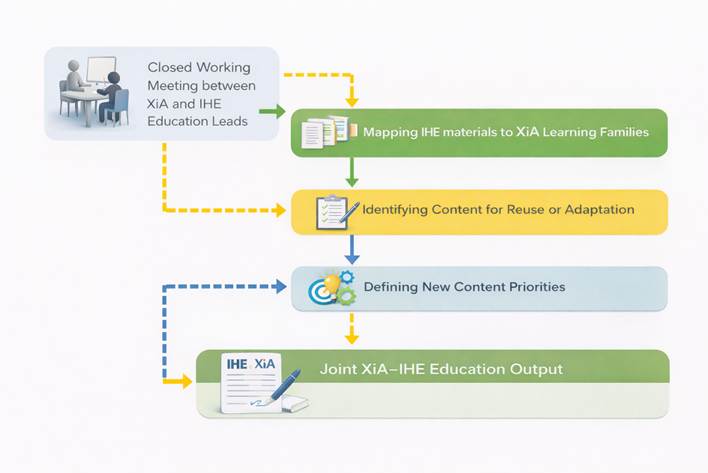
The session will conclude with a closed working meeting between XiA and IHE education leads to translate insights into concrete actions
This includes:
- mapping existing IHE materials to XiA learning families,
- identifying content suitable for reuse or adaptation,
- defining new content priorities,
- and agreeing on a joint XiA–IHE education output.
This structured follow-up reflects XiA’s broader methodology: educational cooperation must lead to tangible artefacts, not just shared intentions.
Strengthening the European interoperability skills ecosystem
IHE Europe’s role as an associated partner highlights a fundamental principle of XiA: interoperability skills development cannot be separated from the standards organisations that define and operationalise those standards.
By aligning IHE’s educational evolution with the XiA Framework — and by explicitly recognising IHE profiles and Testing & Validation as distinct but connected competency families — the collaboration contributes to a more coherent European digital health training landscape.
As Europe moves towards large-scale EHDS implementation, the challenge is no longer to define standards. It is to ensure that professionals across the ecosystem can understand, implement, test and sustain them.